Adventures in product: the first 90 days
The importance of systems for learning how to learn.
This is part of a series following my journey into product management.
This year is the second time I’ve made a significant role change. The first was moving from an engineer to an engineering manager role, which was fundamentally about switching from writing software to supporting individuals. In many ways that was a bigger change than my current lateral move into product management, but I’ll save that reflection for another post.
The specifics of these two transitions are different, but both have followed the same underlying paradigm to answer the question:
How do you learn something new, broad, and complex?
One-off approaches to learn some new topic X or discipline Y certainly work, but the biggest gains are found in developing a repeatable way to learn. In other words, a learning system.
My learning system
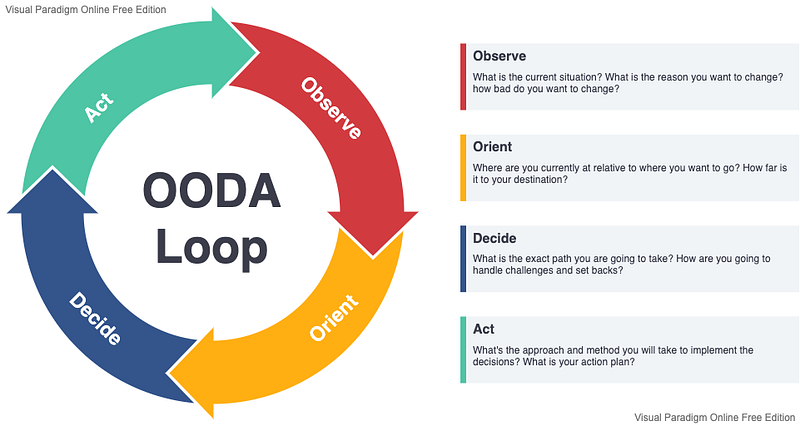
Source: Visual Paradigm
Mental models are simplified representations for how things work and can be useful to help understand complex systems and make decisions in them. The most prominent mental model in my learning system is the OODA loop, a four-stage cycle for information ingestion, processing, and acting originally developed in the U.S. Air Force.
Stage 1: Observe
This stage is all about information gathering and is where I spend the most of my first 30 days. My goal for this stage is to understand what things exist, how things work, and why things are the way they are.
When I moved into new roles as a people manager and a product manager, I had to gather information on two distinct areas: the new systems I’d be operating within, and the role itself. For example: What systems would I be shaping as a product manager? What does effective product leadership involve?
For both information gathering areas, I started by casting a wide net:
- I talked to as many people as possible who I’d be working with or who had first-hand experience with the role. This included folks outside of my org and the company, too. I followed this approach and set up 30-minute 1:1s with each person where I asked the same set of questions: What should I know? What challenges do you see? Who else should I talk to?
- I subscribed to newsletters, joined Slack groups, and created reading lists to get a broad and diverse set of perspectives on the role. You can find the full list of resources I used at the end of this post.
It sure felt like information overload at first, but it was necessary. Without first knowing what’s out there, it’s difficult to define better information filtering. As I learned more about the role and the systems I’d be operating within, I was able to be more selective with what I ingested and more specific with the questions I asked.
Stage 2: Orient
The mountain of observations and information collected in the previous stage needs to be processed into something useful. With the context—and especially biases—of each observation in mind, I started to build my own mental models of each of the systems I needed to understand.
As a new engineering manager, this mental model creation was mostly unconscious. As a new product manager, however, I tried to be more explicit by drawing these mental models as system diagrams or by explaining them in posts like these. It’s the Feynman Learning Technique in action: you don’t truly understand something unless you can explain it to a stranger.
These mental models aren’t static; I continuously refine them based on new information and feedback. Feedback from individuals is a good start, but the best feedback comes from experimenting with and observing changes in the real world. Enter the final stages.
Stage 3 & 4: Decide & Act
The feedback and mental models I’ve developed at this point have given me a holistic understanding of the systems involved. Well, holistic enough for me to start pressure testing it by making changes in the real world.
Some people recommend only starting with small changes. Others make large, sweeping changes early in their role. The former can fail to capitalize on the fresh outside perspective you bring to the role—a perspective that’s lost if you wait too long. A common example of the latter is the new leader who immediately reorganizes the reporting and ownership structure of the team. This can be problematic too if you don’t fully understand the reasons why things are the way they are (aka Chesterton’s Fence).
Either approach applied exclusively will likely be less successful than a blended, highly contextual approach. This is what I follow:
- What are the least disruptive improvements I can make that will (a) allow me to safely test my understanding and (b) start to build trust and momentum?
- What are the highest-leverage improvements that will have an outsized effect on the people, systems, and organization?
Rinse & repeat
Like the name says, this OODA loop is a repeating cycle. The first iteration can take 30–90 days, but additional cycles are much faster. By the end of the first iteration, I try to have a set of processes established that enable regular information gathering, feedback, synthesis, and action. For example:
- Weekly 1:1s with individuals I work with to get feedback on what I should do and what I’ve done
- Regular surveys to everyone I’ve worked with to learn what I’m doing well, what I can improve, and any blind spots
- A regularly-reviewed decision log that identifies decisions that need to be or have been made, why, the approaches considered, and the outcomes
- A regular writing habit to clarify my thinking (like this post)
- A daily reading habit to continually discover new and divergent ideas
Learning resources
Product
Courses:
Newsletters:
Articles:
- Circles framework
- Start Talking! How To Do Customer Interviews That Reveal Priceless Insights
- Product Talk: Customer interview articles
- Collection of UX research articles
Books on vision, strategy, and organization:
- Build What Matters: Delivering Key Outcomes with Vision-Led Product Management by Ben Foster
- Outcomes Over Output: Why customer behavior is the key metric for business success by Josh Seiden
- INSPIRED: How to Create Tech Products Customers Love by Marty Cagan
- EMPOWERED: Ordinary People, Extraordinary Products by Marty Cagan
- Escaping the Build Trap: How Effective Product Management Creates Real Value by Melissa Perri
- Product Leadership: How Top Product Managers Launch Awesome Products and Build Successful Teams by Richard Banfield
- Good Strategy/Bad Strategy: The difference and why it matters by Richard Rumelt
- Measure What Matters: How Google, Bono, and the Gates Foundation Rock the World with OKRs by John Doerr
- Thinking in Bets: Making Smarter Decisions When You Don’t Have All the Facts by Annie Duke
- Team Topologies: Organizing Business and Technology Teams for Fast Flow by Matthew Skelton
Books on customer research:
- The Mom Test: How to talk to customers & learn if your business is a good idea when everyone is lying to you by Rob Fitzpatrick
- Why You Are Asking the Wrong Customer Interview Questions by Teresa Torres
Engineering
Newsletters:
Books:
- An Elegant Puzzle by Will Larson
People leadership
Books:
- Drive by Daniel Pink
Blogs:
- Rands in Repose (there’s a Slack group as well)
General problem solving and systems thinking
Courses:
Newsletters:
- Farnam Street (clearly one of my favorites, if you can’t tell by the number of links in this post)
Books:
- Thinking, Fast and Slow by Daniel Kahneman
- The Fifth Discipline: The Art & Practice of The Learning Organization by Peter Senge
- The Fifth Discipline Fieldbook: Strategies for Building a Learning Organization by Art Kleiner
- The Great Mental Models: Volume 1 by Shane Parrish
- Out of the Crisis by W. Edwards Deming
- Thinking in Systems by Donella H. Meadows
Psychology
- Switch: How to Change Things When Change Is Hard by Chip Heath
- Made to Stick: Why Some Ideas Survive and Others Die by Chip Heath
- Influence: The Psychology of Persuasion by Robert Cialdini
- Atomic Habits: An Easy & Proven Way to Build Good Habits & Break Bad Ones by James Clear
Design
- Lean UX: Designing Great Products with Agile Teams by Jeff Gothelf
- Articulating Design Decisions: Communicate with Stakeholders, Keep Your Sanity, and Deliver the Best User Experience by Tom Greever
Other
- Sapiens: A Brief History of Humankind by Yuval Noah Harari
- The Inevitable: Understanding the 12 Technological Forces That Will Shape Our Future by Kevin Kelly
- Deep Work by Cal Newport
- Death by Meeting by Patrick Lencioni